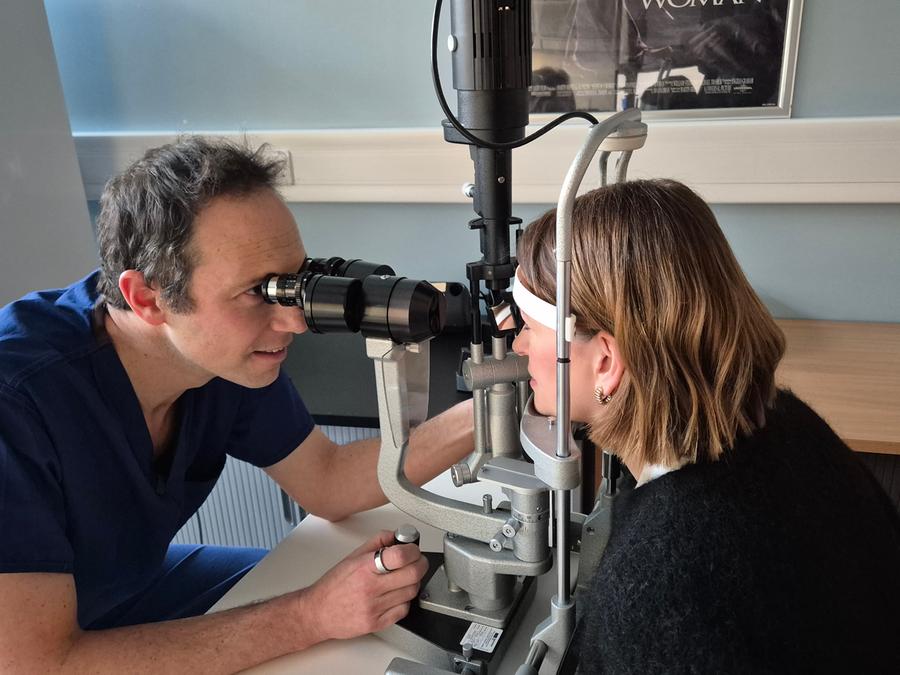
A pioneering treatment developed by Dr. Harry Petrushkin at Moorfields Eye Hospital has successfully restored vision in patients suffering from hypotony, a rare eye condition previously deemed incurable. The breakthrough has been particularly impactful for Nicki Guy, a 47-year-old patient whose eyesight significantly improved after undergoing this innovative therapy.
Hypotony occurs when there is unusually low pressure within the eyeball, leading to its collapse and potentially resulting in blindness. Dr. Petrushkin, who specializes in treating inflammatory eye conditions, noted that seven out of eight patients at Moorfields have benefitted from this new approach. “I was amazed that she did so well,” Dr. Petrushkin said, reflecting on Guy’s remarkable recovery. “It’s a fantastic result, more than I ever could have hoped for.”
Innovative Approach to Treatment
Guy first sought treatment from Dr. Petrushkin in 2019 after experiencing vision problems following the birth of her son in 2017. Prior ophthalmologists had prescribed eye drops, but a routine cataract surgery led to sudden blindness in her affected eye. “Her eye just deflated,” Dr. Petrushkin recounted. The following two years involved attempts to prevent the same fate from occurring in her other eye, but conventional treatments proved ineffective.
As Dr. Petrushkin prepared for surgery on Guy’s second eye, he faced a critical decision. “We were at a point where we could either use a standard silicone-based oil or attempt something different,” he said. With support from his team, they decided to inject hydroxypropyl methylcellulose (HPMC), a clear gel, into Guy’s eye biweekly over ten months to restore its shape.
“We were taught that was end-stage eye disease, you can’t do anything about that. And that has always bothered me quite a lot,” Dr. Petrushkin said. He explained that the key to their success lay in the frequency and consistency of the treatment. “The way we chose to do it, and to repeatedly do it, with a target in mind, is the new thing about this research,” he added.
Life-Changing Outcomes
Guy described the treatment as “life-changing,” expressing gratitude for the regained ability to see her child grow up. “I’ve gone from counting fingers and everything being really blurry to being able to see,” she shared with the BBC. The response to this treatment could potentially benefit between 500 and 1,000 patients annually, according to Dr. Petrushkin’s estimates.
He emphasized the unique position of ophthalmologists, who frequently witness transformative outcomes for their patients. “One of the great things about ophthalmology is that you constantly have patients come up to you and say, ‘You changed my life. I was blind, and now I can see,’” he said.
Dr. Petrushkin hopes this breakthrough fosters a shift in perspective among his colleagues regarding patients previously considered to have no hope. “It has given me a soapbox that I can stand on and say to colleagues: ‘Don’t stop thinking,’” he concluded.
The implications of this treatment extend beyond individual patient outcomes; they challenge the conventional wisdom surrounding the limits of eye care and encourage a more open-minded approach to potential solutions for serious conditions like hypotony.