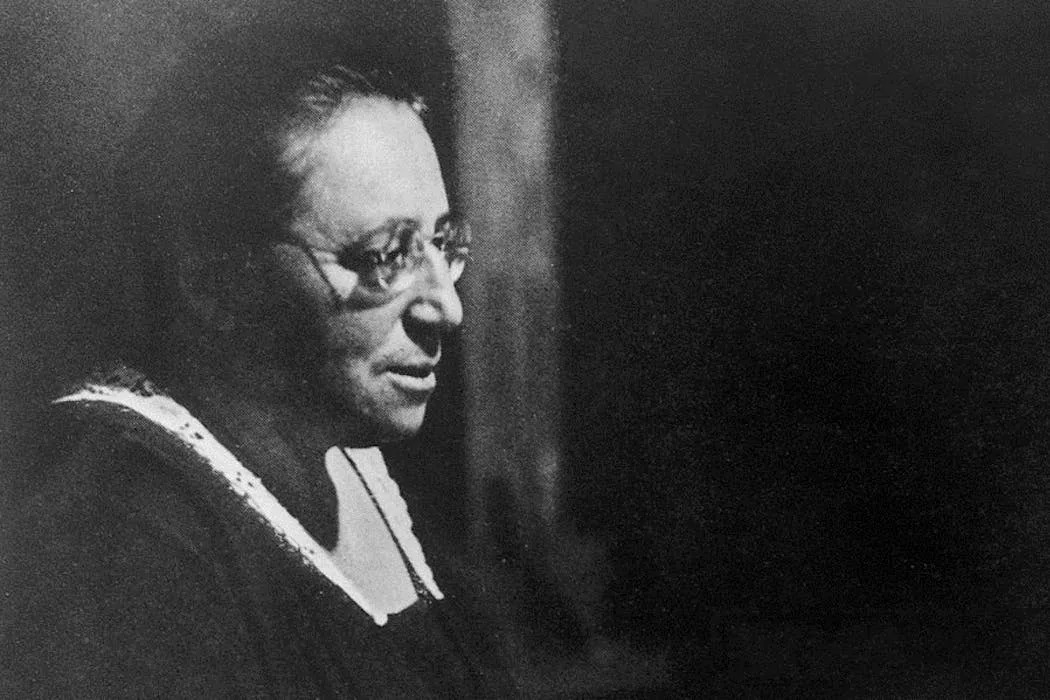
Emmy Noether, a pioneering figure in mathematics, made significant contributions to ring theory, a branch of theoretical mathematics, during a time when women faced immense barriers in academia. In March 1933, she was dismissed from her position at the University of Göttingen due to Nazi policies targeting Jewish faculty. Her work, particularly her 1921 paper on ring theory, continues to influence modern mathematics.
Born in 1882 in Erlangen, Germany, Noether demonstrated an early aptitude for mathematics. Despite her father’s position as a math professor, she encountered obstacles that limited women’s access to higher education at the time. German universities only began admitting women in 1903, allowing Noether to enroll at Erlangen University, where she eventually earned her doctorate.
Despite her qualifications, Noether faced exclusion from academic positions because of her gender. She unofficially supervised doctoral students and contributed to research, even while being denied formal status. In 1919, after years of perseverance, she finally gained lecturer status at the University of Göttingen.
Groundbreaking Contributions to Ring Theory
Noether’s revolutionary work in ring theory emerged shortly after she became an official lecturer. Her research fundamentally changed the understanding of mathematical structures known as rings, which are collections of elements that can be added, subtracted, and multiplied. One of the classic examples of a ring is the set of integers, denoted as Z. This set includes both positive and negative whole numbers and remains a core concept in mathematics.
Noether’s insights led to the development of Noetherian rings, a class of rings that share common structural properties. These rings have become essential not only in ring theory but also in broader mathematical fields such as number theory and algebraic geometry. Her ability to identify underlying patterns in mathematical structures continues to guide mathematicians today.
In addition to her contributions to mathematics, Noether also engaged with theoretical physics, collaborating with notable figures such as Albert Einstein. Her work provided significant insights into the foundations of Einstein’s theory of relativity, further establishing her reputation as a leading mathematician.
Perseverance Amid Adversity
Following her dismissal from the University of Göttingen in 1933, Noether faced uncertainty and professional isolation. The Nazi regime’s laws prohibited Jewish individuals from holding academic positions, forcing her to seek opportunities outside Germany. She received an offer from Bryn Mawr College in Pennsylvania, which had established a fund to support refugee scholars.
At Bryn Mawr, Noether continued her work and mentored several young women in advanced mathematics. Tragically, her tenure there was cut short when she passed away unexpectedly in April 1935, just four days after undergoing surgery for a tumor. Mathematician Hermann Weyl poignantly described her death as “the echo of a thunderclap,” reflecting the profound impact she made in her short life.
Noether’s legacy endures through her groundbreaking contributions to mathematics, which continue to inspire new generations of mathematicians. Her story, characterized by resilience and brilliance, serves as a reminder of the barriers faced by women and minorities in academia. Today, Noether is celebrated not only for her mathematical genius but also for her unyielding spirit in the face of adversity.
This article highlights the life and achievements of Emmy Noether, a mathematician whose work transcended her time and continues to shape modern mathematical thought. As her centenary in ring theory approaches, her contributions remain a testament to the vital role of diversity in academia and the importance of recognizing the achievements of those who have been historically marginalized.