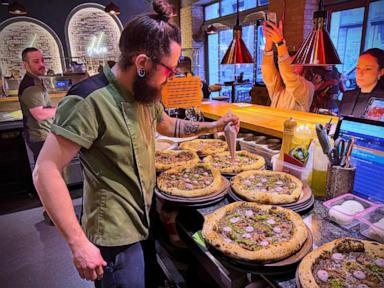
A unique dining experience has emerged in Budapest, Hungary, where Neverland Pizzeria is offering a limited-edition pizza inspired by ancient Roman cuisine. This innovative creation invites diners to explore flavors that predate modern pizza, featuring ingredients that were historically available more than two millennia ago.
Josep Zara, the founder of Neverland Pizzeria, spearheaded the project out of curiosity about what pizza might have been like in ancient Rome. “We went all the way back to the Roman Empire and wondered whether they even ate pizza at the time,” he explained. While the concept of pizza as we know it today did not exist during that era—largely due to the absence of tomatoes and mozzarella—Zara’s team sought to recreate the oven-baked flatbreads that Romans enjoyed, often topped with herbs and various cheeses.
Recent archaeological discoveries, such as a 2023 fresco unearthed in Pompeii, depicting a focaccia-like flatbread garnished with pomegranate seeds, dates, and spices, inspired Zara. This prompted him to question the flavors of ancient Roman dishes, leading to intensive research into Roman culinary practices. Consulting historical texts, including the ancient cookbook De re coquinaria, Zara compiled a list of ingredients that would have been common in Roman kitchens.
Zara collaborated closely with the pizzeria’s head chef, László Bárdossy, to innovate within the constraints of historical accuracy. “We had to exclude all ingredients that originated from America,” Zara noted. This meant no tomatoes or mozzarella, pushing the team to experiment with alternatives that would have been available during Roman times.
The process involved considerable trial and error. Bárdossy described the challenge of creating pizza dough without modern conveniences, highlighting that over 80% of pizza dough typically consists of water. “The fact that there wasn’t infrastructure like a water system at the time of the Romans made things difficult for us,” he said. Ultimately, they found success by using fermented spinach juice to help the dough rise, along with ancient grains such as einkorn and spelt.
The resulting pizza is a dense flatbread topped with ingredients reflective of Roman aristocratic cuisine. Diners can expect to find epityrum, an olive paste, as well as garum, a fermented fish sauce that was prevalent in ancient Roman cooking. Additional toppings include confit duck leg, toasted pine nuts, ricotta, and a grape reduction, creating a dish that is both a culinary experiment and a nod to history.
Bárdossy explained that the creation is not intended to be an everyday meal for most diners. “There is a narrow niche that thinks this is delicious and is curious about it, while most people want more conventional pizza, so it’s not for everyday eating. It’s something special,” he said.
For Zara, this project embodies the philosophy of Neverland Pizzeria. “We’ve always liked coming up with new and interesting things, but tradition is also very important for us,” he stated. The balance between innovation and historical respect is central to their culinary approach. Despite their adventurous spirit, Zara emphasized one modern boundary: “But of course, we definitely do not use pineapple.”
This intriguing fusion of history and gastronomy not only enriches Budapest’s culinary scene but also invites patrons to step into a flavorful journey through time.