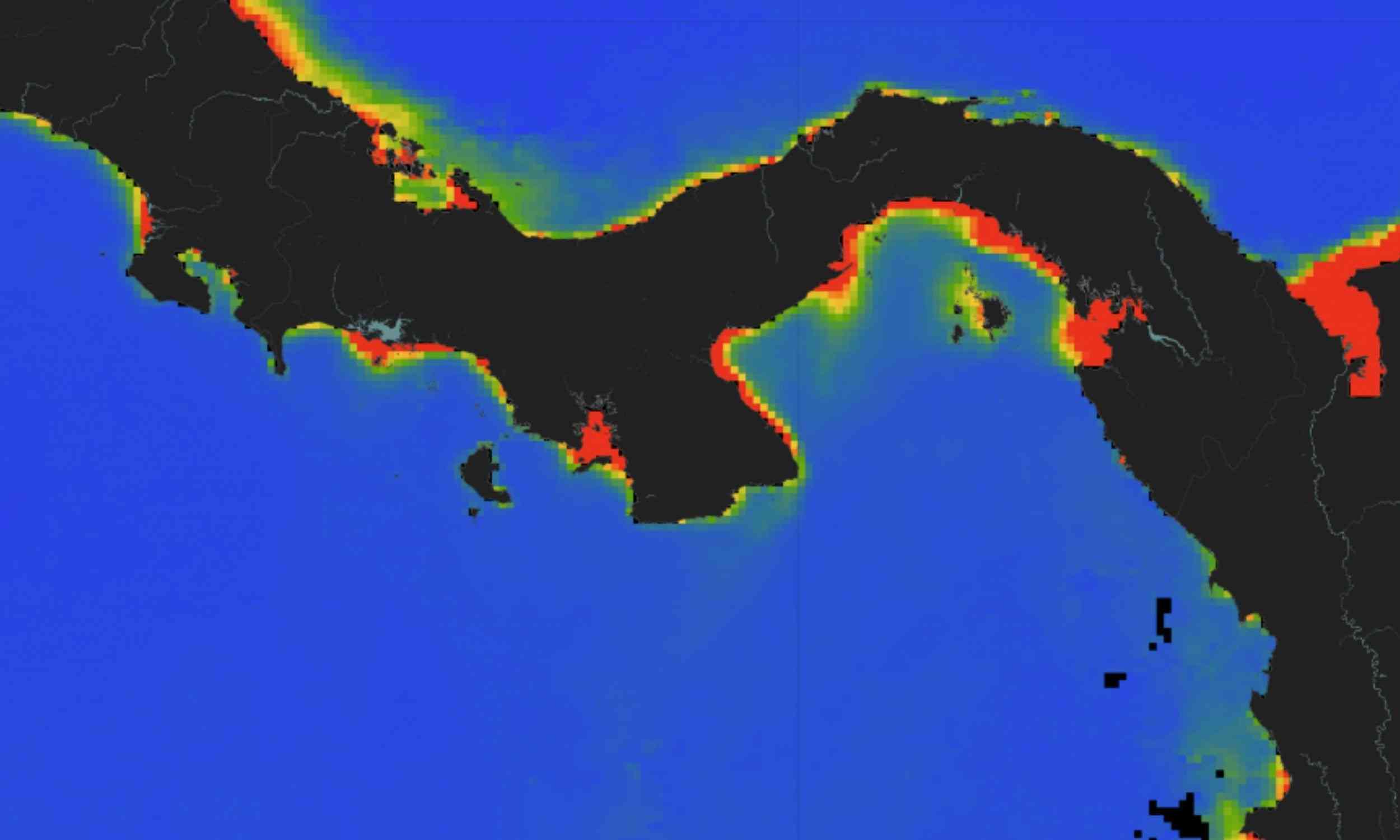
Seasonal Upwelling in Gulf of Panama Fails for First Time in Four Decades
New research confirms the Gulf of Panama’s seasonal ocean upwelling—the “ocean’s breath” vital for cooling and marine life—failed entirely in 2025, breaking a 40-year pattern. This unprecedented disruption leaves warm waters in place, threatening marine ecosystems and coastal communities that have depended on this natural cycle for generations.
Oceanographer Aaron O’Dea and colleagues at the Smithsonian Tropical Research Institute (STRI) documented that the expected seasonal drop in water temperature and surge in nutrients did not occur. Typically, strong northerly winds push surface waters offshore during Panama’s dry season, allowing cold, nutrient-rich deep water to rise—a process known as upwelling. This feeds phytoplankton blooms which power the entire marine food chain and cool coastal waters.
In all previous years dating back to 1985 (satellite data) and 1995 (in-water temperature logs), the seasonal cooling appeared predictably by January 20. However, in 2025, the Gulf’s waters did not cool until March 4, more than six weeks late. Even then, the cooler period lasted just 12 days instead of the usual two months, and the water never reached historically cold temperatures.
Winds Blamed as Upwelling Fails by Losing Frequency
Surprisingly, the strength of the northerly winds remained near normal, but their frequency fell sharply—occurring 74% less often across the season. Longer lulls between wind bursts meant surface waters were not pushed offshore consistently enough to let cold water rise. STRI researchers found warm water stacked in layers through the water column, where cold water normally emerges.
This weakened upwelling eliminated the critical seasonal cooling that Pacific reefs and fish populations depend on. Earlier studies found seasonal cooling helps corals survive extreme heat spikes linked to El Niño events by providing a thermal refuge. Without this cooling, reefs face elevated thermal stress, increasing risks of bleaching and damage with repeated hot seasons.
Wider Environmental and Human Risks Emerge
While a weak La Niña was present in 2025, its effect could not explain the upwelling failure, signaling regional dynamics beyond broad Pacific climate cycles. O’Dea emphasized,
“Panama’s 2025 upwelling failure underscores that regional-scale dynamics, rather than blanket global predictions, are essential for understanding these tropical upwelling systems.”
Coastal communities that rely on fisheries for food and income may face immediate impacts. The nutrient pulse that supports smaller fish and plankton disappeared, threatening the food web and livelihoods along Panama’s Pacific shore.
Global Implications and Next Steps
This historic failure highlights a challenge for ocean monitoring in tropical upwelling zones that often lack long-term data. Panama’s extensive datasets make this event clear, but other regions may have experienced similar failures unnoticed. STRI scientists are now closely monitoring the 2026 dry season, with early reports showing a return to strong cooling—illustrating that 2025 could be an anomaly rather than a permanent shift.
Still, the need for improved forecasting and expanded monitoring is urgent. Coastal communities worldwide cannot plan or adapt without reliable data on these vital ocean cycles. The 2025 upwelling failure in the Gulf of Panama serves as a clear warning that even well-established natural patterns can falter suddenly with significant ecological and economic consequences.
The full findings were published in the Proceedings of the National Academy of Sciences. STRI continues weekly updates on their public monitoring page to watch how conditions unfold in 2026.
This developing ocean disruption underscores a growing urgency to understand and adapt to rapid environmental changes affecting marine systems and the people who depend on them globally—including the US and regions like Ohio, where seafood imports and climate impacts connect communities across oceans.